Employee onboarding has changed dramatically in recent years. In 2026, companies are no longer relying only on paperwork, manual coordination, and endless email follow ups to onboard new hires.
Artificial Intelligence is transforming onboarding into a faster, smarter, and more efficient process. Businesses are now using AI powered onboarding solutions to reduce HR workload, improve employee experiences, and help new hires become productive more quickly.
For HR teams handling multiple hires across departments and locations, AI is becoming an essential part of modern onboarding strategies.
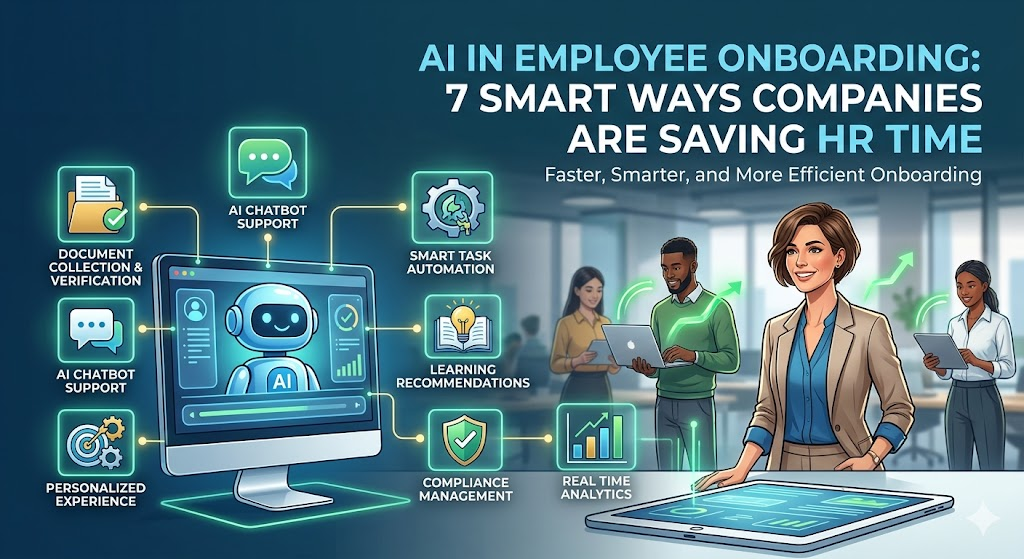
In this article, we will explore 7 smart ways companies are using AI in employee onboarding to save HR time and improve efficiency.
What is AI Employee Onboarding?
AI employee onboarding refers to the use of Artificial Intelligence technologies to automate and optimize onboarding tasks for new employees.
AI tools can help HR teams manage:
- Document collection
- Employee communication
- Training recommendations
- Task automation
- Workflow management
- Employee support
Instead of manually handling repetitive onboarding activities, HR teams can use AI systems to create a smoother and faster onboarding experience.
Why Companies Are Using AI for Onboarding in 2026
As businesses continue to scale remote, hybrid, and global workforces, traditional onboarding methods are becoming difficult to manage.
Companies are turning to AI onboarding solutions because they help:
- Reduce manual HR tasks
- Improve onboarding speed
- Enhance employee engagement
- Minimize onboarding errors
- Provide personalized experiences
- Save operational costs
AI allows HR professionals to focus more on employee relationships and workplace culture rather than repetitive administrative work.
1. Automated Document Collection and Verification
One of the most time consuming onboarding tasks is collecting employee documents.
HR teams often spend hours following up for:
- ID proofs
- Tax forms
- Employment agreements
- Bank details
- Compliance documents
AI onboarding systems can automatically:
- Send document reminders
- Verify uploaded documents
- Detect missing information
- Organize employee records securely
This reduces delays and eliminates repetitive manual follow ups.
2. AI Chatbots for Instant Employee Support
New employees usually have many onboarding questions.
Instead of relying entirely on HR teams for support, companies are using AI chatbots to provide instant assistance.
AI onboarding chatbots can answer questions related to:
- Company policies
- Leave rules
- Payroll information
- IT setup
- Training schedules
- Employee benefits
This helps HR teams save significant time while ensuring employees receive immediate support.
3. Personalized Onboarding Experiences
Every employee role requires different onboarding steps.
AI can analyze employee profiles, departments, skills, and job roles to create personalized onboarding journeys.
For example:
- Sales employees receive CRM training
- Developers receive technical onboarding modules
- Managers receive leadership resources
This personalized approach improves engagement and helps employees adapt faster.
4. Smart Task Automation for HR Teams
AI onboarding platforms automate repetitive onboarding workflows that normally require manual coordination.
These tasks include:
- Sending welcome emails
- Assigning onboarding checklists
- Scheduling orientation sessions
- Creating IT access requests
- Tracking onboarding progress
Automation reduces administrative workload and ensures nothing is missed during onboarding.
5. AI Driven Learning and Training Recommendations
Training is a critical part of onboarding.
AI systems can recommend learning materials based on:
- Employee roles
- Skills
- Experience levels
- Department requirements
Instead of assigning generic training programs, companies can provide targeted learning experiences that improve employee productivity more quickly.
This saves HR teams time spent manually assigning training modules.
6. Faster Compliance and Policy Management
Compliance paperwork is often one of the biggest onboarding bottlenecks.
AI helps companies simplify compliance management by:
- Automating policy acknowledgments
- Tracking pending compliance tasks
- Sending deadline reminders
- Maintaining digital records
This reduces compliance risks while helping HR departments stay organized.
7. Real Time Onboarding Analytics
AI onboarding systems provide detailed analytics that help HR teams improve onboarding performance.
Companies can track:
- Onboarding completion rates
- Employee engagement levels
- Training progress
- Time to productivity
- Common onboarding issues
These insights help organizations identify gaps and continuously improve onboarding experiences.
How AI Saves HR Time During Onboarding
| Onboarding Activity | Traditional Process | AI Powered Process |
|---|---|---|
| Document Collection | Manual follow ups | Automated reminders |
| Employee Queries | HR email support | AI chatbot assistance |
| Training Assignment | Manual allocation | Smart recommendations |
| Task Tracking | Spreadsheets and emails | Automated workflows |
| Compliance Management | Manual tracking | AI based monitoring |
| Employee Communication | Delayed responses | Instant communication |
| Progress Reporting | Manual reporting | Real time analytics |
Benefits of AI in Employee Onboarding
Reduced Administrative Work
AI automates repetitive onboarding activities, allowing HR teams to focus on strategic initiatives.
Faster Employee Integration
Employees receive quicker access to resources, tools, and training materials.
Improved Employee Experience
AI driven onboarding creates smoother and more engaging onboarding journeys.
Better Accuracy and Compliance
Automation reduces human errors and improves documentation management.
Increased HR Efficiency
HR departments can handle larger onboarding volumes without increasing workload.
Challenges of AI in Onboarding
While AI onboarding offers many benefits, there are still some challenges organizations should address.
Data Privacy Concerns
Companies must ensure employee data is handled securely and follows compliance regulations.
Over Automation Risks
Too much automation may reduce personal interaction during onboarding.
New hires still value human communication and support.
Integration with Existing Systems
Organizations may face technical challenges while integrating AI onboarding tools with HR software.
Best Practices for AI Employee Onboarding
To successfully implement AI onboarding solutions, companies should:
Maintain Human Interaction
AI should support onboarding, not completely replace HR teams.
Use AI for Repetitive Tasks
Focus automation on administrative and time consuming processes.
Personalize Employee Experiences
Use AI insights to tailor onboarding journeys based on employee roles.
Monitor AI Performance
Regularly review onboarding analytics and employee feedback.
Frequently Asked Questions About AI Employee Onboarding
What is AI employee onboarding?
AI employee onboarding is the use of Artificial Intelligence to automate onboarding tasks such as document collection, employee communication, training management, and workflow automation.
How does AI help HR teams during onboarding?
AI reduces manual HR work by automating repetitive tasks, improving communication, managing workflows, and providing onboarding analytics.
Can AI improve employee onboarding experience?
Yes. AI improves onboarding experiences by offering faster communication, personalized training, instant support, and smoother onboarding processes.
What tasks can AI automate in onboarding?
AI can automate:
- Document collection
- Welcome emails
- Interview scheduling
- Compliance tracking
- Employee queries
- Training recommendations
Are AI onboarding systems suitable for remote employees?
Yes. AI onboarding platforms are especially useful for remote and hybrid teams because they provide digital onboarding experiences and automated communication.
Does AI replace HR professionals in onboarding?
No. AI supports HR teams by handling repetitive tasks, while HR professionals continue managing employee engagement and workplace relationships.
What are the benefits of AI onboarding software?
Key benefits include:
- Faster onboarding
- Reduced HR workload
- Better compliance management
- Improved employee engagement
- Increased operational efficiency
Final Thoughts
AI in employee onboarding is helping companies save valuable HR time while improving onboarding efficiency and employee experiences.
From automated workflows and chatbot support to personalized learning and real time analytics, AI is simplifying onboarding processes across industries.
As organizations continue adopting digital HR technologies in 2026, AI onboarding solutions will play a major role in helping businesses onboard employees faster, smarter, and more effectively.
Companies that combine AI automation with human support will create stronger onboarding experiences and improve long term employee success.