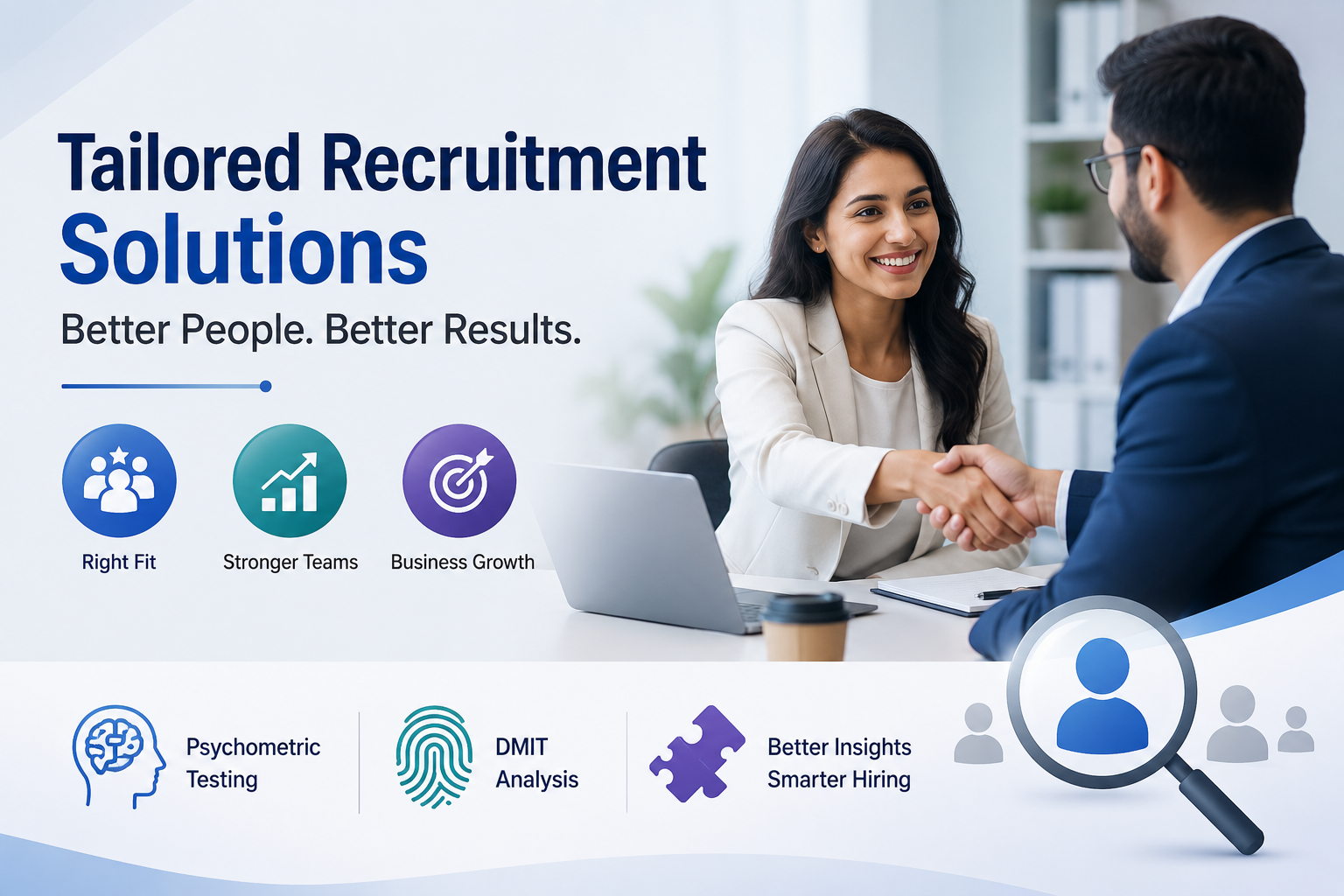
Hiring the right employees has become more challenging than ever. Businesses today are not just searching for candidates with impressive resumes. They are looking for professionals who match the company’s culture, work style, long term goals, and team dynamics.
Traditional recruitment methods often focus only on qualifications and experience. While these factors are important, they do not always reveal whether a candidate will truly succeed within the organization. This is why many companies are now turning toward tailored recruitment solutions that combine strategic hiring with modern assessment methods like psychometric testing and DMIT analysis.
Customized recruitment helps businesses make smarter hiring decisions, reduce employee turnover, and build stronger teams for long term success.
What Are Tailored Recruitment Solutions?
Tailored recruitment solutions are personalized hiring strategies designed around a company’s unique business needs. Instead of using the same hiring process for every role, recruiters create customized plans based on factors such as:
- Industry requirements
- Company culture
- Team structure
- Leadership expectations
- Technical skills needed
- Future business goals
The objective is not simply to fill vacancies quickly, but to find candidates who are the best fit for the role and the organization.
Modern tailored recruitment often includes advanced evaluation techniques such as:
- Psychometric assessments
- DMIT analysis
- Behavioral interviews
- Skill based testing
- Personality profiling
- Leadership assessments
These tools help employers gain deeper insights into a candidate’s abilities, thinking patterns, and workplace compatibility.
Why Traditional Hiring Methods Often Fail
Many businesses still rely only on resumes and interviews during recruitment. However, interviews alone may not accurately predict job performance or long term success.
Some common hiring challenges include:
- High employee turnover
- Poor cultural fit
- Skill mismatches
- Low workplace engagement
- Weak team collaboration
- Reduced productivity
A candidate may have strong qualifications but still struggle in a fast paced work environment or fail to adapt to company culture.
Tailored recruitment solutions address these problems by evaluating candidates more holistically.
How Psychometric Testing Improves Recruitment
Psychometric testing has become one of the most effective tools in modern hiring. These assessments measure a candidate’s personality traits, cognitive abilities, emotional intelligence, and behavioral tendencies.
Psychometric tests help businesses understand:
- Communication style
- Problem solving ability
- Leadership potential
- Stress management
- Decision making skills
- Team compatibility
- Workplace motivation
For example, a sales role may require high confidence and communication skills, while a research position may demand analytical thinking and attention to detail.
Psychometric testing helps recruiters identify candidates whose personalities naturally align with the role.
Benefits of Psychometric Assessments
Better Hiring Accuracy
Psychometric evaluations provide data driven insights that reduce guesswork in recruitment decisions.
Improved Team Compatibility
Understanding personality traits helps businesses build balanced teams with better collaboration and communication.
Reduced Employee Turnover
Employees who fit the role and company culture are more likely to stay longer and perform better.
Stronger Leadership Identification
Psychometric testing helps organizations identify future leaders with high emotional intelligence and decision making abilities.
The Growing Role of DMIT in Recruitment
DMIT, or Dermatoglyphics Multiple Intelligence Test, is another emerging assessment method used by some organizations and career consultants during recruitment and talent evaluation.
DMIT is based on the study of fingerprint patterns and is believed to provide insights into an individual’s natural strengths, learning styles, intelligence types, and behavioral tendencies.
Some recruitment and HR professionals use DMIT to better understand:
- Natural skill orientation
- Creative and analytical strengths
- Communication preferences
- Learning capabilities
- Leadership tendencies
- Career suitability
For example, candidates with strong analytical abilities may be more suitable for technical roles, while individuals with creative intelligence may excel in marketing or design positions.
How DMIT Supports Tailored Recruitment
Role Alignment
DMIT can help identify candidates whose natural abilities align with specific job roles.
Personalized Employee Development
Businesses can use DMIT insights to create customized training and career growth plans.
Improved Workforce Productivity
Employees working in roles suited to their strengths often show better performance and higher job satisfaction.
Better Career Planning
Organizations can place employees in departments where they are more likely to succeed and grow.
Combining Human Expertise with Technology
Modern recruitment solutions combine human judgment with advanced hiring technology. Recruiters use AI driven sourcing tools, applicant tracking systems, and analytics platforms alongside psychometric and behavioral assessments.
This combination allows businesses to:
- Identify high quality candidates faster
- Improve candidate screening
- Reduce hiring bias
- Enhance recruitment efficiency
- Make data backed hiring decisions
Technology speeds up recruitment, while tailored assessments improve hiring quality.
Customized Recruitment Creates Better Candidate Experiences
A personalized hiring process also improves the candidate experience. Applicants appreciate recruitment processes that focus on their strengths, personality, and career aspirations rather than treating them as just another resume.
Tailored recruitment solutions often include:
- Clear communication
- Structured interviews
- Personalized feedback
- Skill focused evaluations
- Career alignment discussions
Candidates who have positive recruitment experiences are more likely to accept job offers and recommend the company to others.
Long Term Benefits for Businesses
Businesses that invest in tailored recruitment strategies often experience long term advantages such as:
- Stronger employee retention
- Higher workplace productivity
- Better employee engagement
- Reduced recruitment costs
- Improved leadership development
- Healthier organizational culture
When employees are hired based on both skills and behavioral compatibility, companies build more stable and effective teams.
Choosing the Right Recruitment Partner
Businesses should choose recruitment providers that understand both traditional hiring and modern talent assessment techniques.
A strong recruitment partner should offer:
- Industry expertise
- Customized hiring strategies
- Psychometric evaluation support
- Transparent communication
- Talent mapping services
- Long term workforce planning
Companies should also ensure that assessments are used ethically and professionally as part of a balanced hiring process.
Frequently Asked Questions
How do tailored recruitment solutions improve hiring quality?
Tailored recruitment focuses on understanding the exact needs of a business before searching for candidates. This helps companies hire professionals who are better suited for the role, work environment, and future growth plans.
Why do companies use psychometric testing during recruitment?
Psychometric testing helps employers understand a candidate’s personality traits, thinking style, communication abilities, and workplace behavior. It gives deeper insights that resumes and interviews alone may not reveal.
Is psychometric testing useful for leadership hiring?
Yes. Many organizations use psychometric assessments to identify leadership qualities such as decision making, emotional intelligence, adaptability, and team management skills.
What makes customized recruitment more effective than standard hiring methods?
Standard hiring often focuses only on qualifications and experience. Customized recruitment evaluates a candidate’s overall compatibility with the company, helping businesses avoid poor hiring decisions and improve retention.
Can tailored recruitment help startups?
Definitely. Startups often need employees who can handle multiple responsibilities and adapt quickly. Tailored hiring strategies help startups find candidates who fit fast moving and growth focused work environments.
How does DMIT support talent identification?
DMIT is used by some recruitment and career assessment professionals to understand natural strengths, learning preferences, and intelligence patterns. It can help guide role alignment and employee development planning.
Are recruitment assessments only for large companies?
No. Small and medium businesses also benefit from recruitment assessments because hiring mistakes can be costly for growing companies. Better screening helps businesses build stronger teams from the beginning.
Do tailored recruitment services save time?
Yes. Since recruiters focus only on candidates who closely match the company’s needs, businesses spend less time reviewing unsuitable applications and conducting unnecessary interviews.
Can recruitment solutions help reduce employee turnover?
Personalized hiring strategies improve the chances of hiring employees who feel comfortable in their roles and connected to the company culture, which often leads to better long term retention.
What industries commonly use tailored recruitment strategies?
Industries such as IT, healthcare, finance, education, manufacturing, consulting, and marketing frequently use customized recruitment methods to attract specialized talent.
Why are businesses moving toward skill and behavior based hiring?
Modern workplaces require more than technical knowledge. Companies now value adaptability, teamwork, communication, and problem solving skills, making behavior based hiring increasingly important.
How does technology support tailored recruitment?
Recruitment technology helps streamline candidate sourcing, application tracking, interview scheduling, and data analysis. Combined with personalized assessments, it creates a more accurate and efficient hiring process.
Final Thoughts
Hiring success depends on more than qualifications alone. Businesses today need employees who can adapt, collaborate, lead, and contribute positively to workplace culture.
Tailored recruitment solutions help organizations move beyond generic hiring methods by combining strategic recruitment with tools like psychometric testing and DMIT analysis. These approaches provide deeper insights into candidate potential, personality, and role compatibility.
As competition for skilled talent continues to grow, businesses that adopt personalized recruitment strategies will be better equipped to build productive, engaged, and future ready teams.