
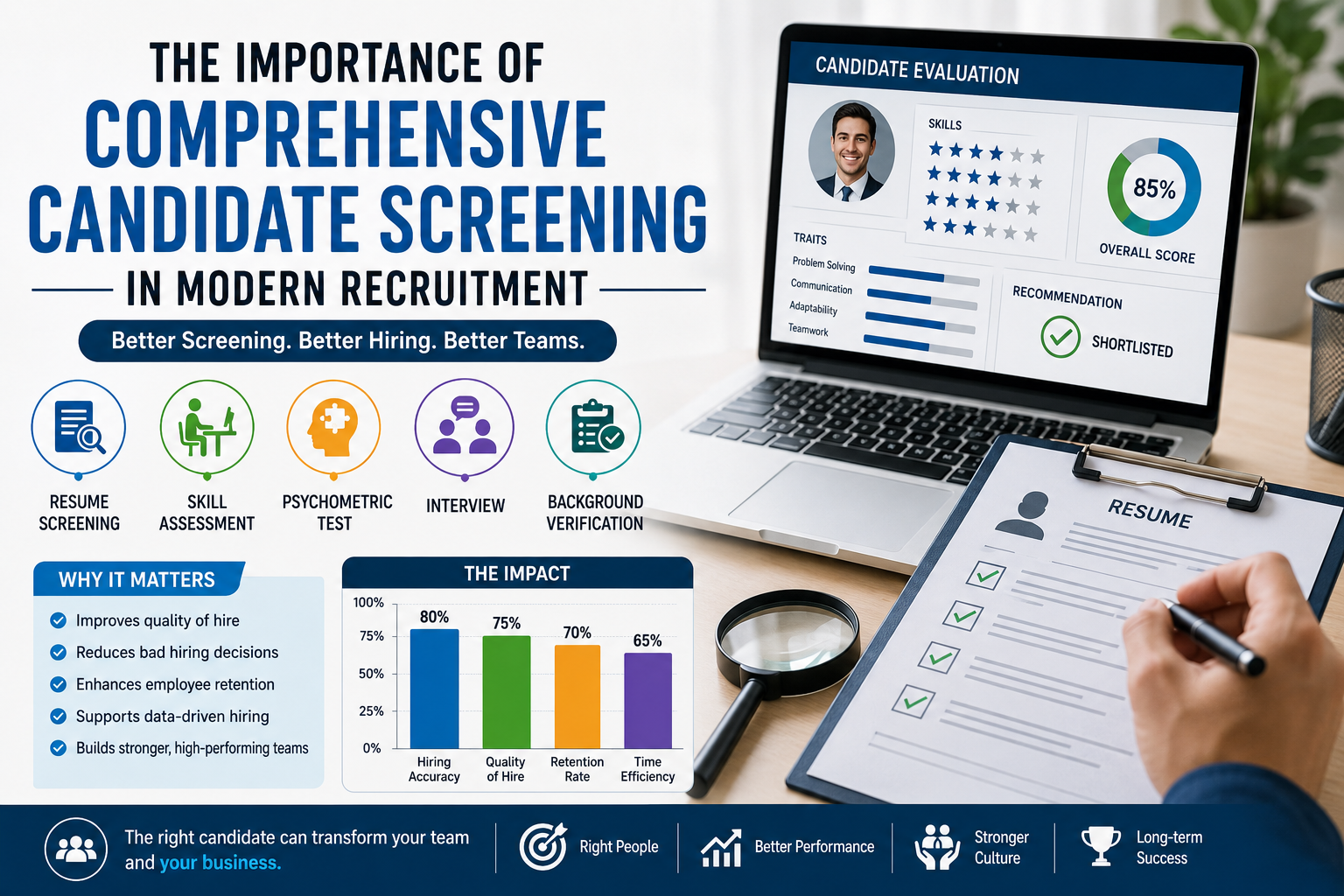
Hiring the right candidate is one of the most important decisions a company can make. A strong employee can improve productivity, support team growth, and contribute to long term business success. On the other hand, a poor hiring decision can lead to low performance, higher turnover, extra training costs, and workplace challenges.
In modern recruitment, companies cannot depend only on resumes or interviews. A resume may show experience, but it does not always reveal a candidate’s actual skills, personality, work style, problem solving ability, or cultural alignment. This is why comprehensive candidate screening has become essential.
Comprehensive candidate screening helps employers evaluate candidates from different angles before making a final hiring decision. It allows recruiters to look beyond qualifications and understand whether a candidate is truly suitable for the role, the team, and the organization.
What Is Comprehensive Candidate Screening?
Comprehensive candidate screening is a structured process of evaluating job applicants using multiple methods. Instead of relying on one source of information, such as a resume or a single interview, it combines different screening tools to create a complete picture of the candidate.
A complete screening process may include resume screening, skill assessments, psychometric tests, structured interviews, reference checks, background verification, and culture alignment checks.
The main goal is to understand whether the candidate has the right skills, behavior, mindset, and potential to succeed in the role.
Key Components of Candidate Screening
| Screening Component | What It Evaluates | Why It Matters |
|---|---|---|
| Resume screening | Education, experience, job history | Helps shortlist candidates who meet basic role requirements |
| Skill assessment | Practical job related ability | Confirms whether the candidate can perform the role |
| Psychometric test | Personality, reasoning, behavior, work style | Gives deeper insight into candidate suitability |
| Structured interview | Communication, motivation, problem solving | Makes candidate evaluation more consistent |
| Reference check | Past performance and professional conduct | Validates previous work experience |
| Background verification | Identity, employment history, credentials | Reduces hiring risk |
| Culture alignment check | Values, work habits, team compatibility | Supports long term retention |
Why Candidate Screening Matters in Modern Recruitment
Recruitment has become more competitive and complex. Companies often receive many applications for a single role, especially through job portals, career pages, and social media platforms. While this gives employers access to more candidates, it also makes shortlisting more difficult.
Without a strong screening process, recruiters may spend time interviewing unsuitable candidates or may hire someone who is not the right fit. This can affect team performance, employee morale, and business outcomes.
Comprehensive candidate screening helps employers make better, fairer, and more confident hiring decisions.
1. It Helps Identify the Right Skills
A candidate may list several skills on a resume, but employers need to know whether those skills can be applied in real work situations. Skill based screening helps confirm practical ability.
For example, a software developer may complete a coding test, a content writer may submit a writing sample, and a sales candidate may participate in a mock sales call. These assessments show how candidates perform tasks related to the actual role.
This helps employers choose candidates based on evidence, not just claims.
2. It Reduces Bad Hiring Decisions
A bad hire can be expensive and time consuming. It can lead to repeated recruitment, additional training, missed targets, and team disruption. Comprehensive screening reduces this risk by giving recruiters more information before making a decision.
When employers assess skills, behavior, communication, and culture alignment together, they are more likely to select candidates who can perform well and stay longer.
3. It Improves Quality of Hire
Quality of hire refers to how successful a new employee is after joining the company. A strong screening process improves quality of hire by matching the right person to the right role.
Candidates who are screened properly are more likely to understand the job expectations, perform effectively, and adapt to the workplace environment. This leads to better productivity and stronger team performance.
4. It Saves Time for Recruiters and Hiring Managers
Recruiters often handle multiple job openings at the same time. Screening helps them filter applications quickly and focus only on the most suitable candidates.
A structured process also saves hiring managers time because they interview candidates who have already passed important evaluation stages. This makes recruitment more efficient and organized.
Candidate Screening Funnel
| Recruitment Stage | Candidate Pool Example | Purpose |
|---|---|---|
| Applications received | 500 | Collect all interested candidates |
| Resume shortlisted | 120 | Filter based on basic role requirements |
| Skill assessment completed | 60 | Check practical ability |
| Psychometric test completed | 35 | Understand behavior and work style |
| Structured interview | 15 | Evaluate role fit and communication |
| Final shortlist | 5 | Select strongest candidates |
| Offer made | 1 | Hire the best matched candidate |
5. It Supports Fair and Objective Hiring
Hiring decisions can sometimes be influenced by personal opinions, first impressions, or unconscious bias. Comprehensive screening helps reduce this by using clear criteria and consistent evaluation methods.
Structured interviews, scoring systems, skill tests, and psychometric assessments allow recruiters to compare candidates more fairly. This supports diversity, equity, and inclusion in recruitment.
6. It Helps Assess Cultural Alignment
Skills are important, but they are not enough. A candidate also needs to work well within the company’s culture. Cultural alignment means the candidate’s values, communication style, and work habits match the organization’s way of working.
For example, a candidate who prefers independent work may not enjoy a highly collaborative environment. Similarly, someone who needs fixed routines may struggle in a fast changing startup culture.
Screening for cultural alignment helps companies hire people who can work well with the team and remain engaged for the long term.
7. It Improves Employee Retention
Employee retention begins at the hiring stage. When candidates are properly screened, both the employer and the candidate understand whether the role is a good match.
This reduces the chances of mismatch after joining. Employees who fit the role and culture are more likely to stay, perform well, and grow with the company.
8. It Helps Predict Future Performance
Modern screening methods are not only used to check current skills. They also help employers understand future potential. Companies need employees who can learn, adapt, solve problems, and take responsibility.
Psychometric tests, behavioral interviews, and situational judgment tests can help predict how candidates may respond to workplace challenges.
The Role of Psychometric Tests in Candidate Screening
Psychometric tests play an important role in modern recruitment. These tests help employers understand a candidate’s personality, reasoning ability, behavior, emotional intelligence, and work style.
Unlike a traditional interview, a psychometric test provides structured insights. It helps recruiters understand how a candidate may think, communicate, handle pressure, solve problems, and work with others.
Psychometric tests should not replace interviews or skill assessments. Instead, they should be used as one part of a complete screening process.
What Psychometric Tests Measure
| Area Measured | What It Shows | Recruitment Use |
|---|---|---|
| Logical reasoning | Ability to analyze patterns and solve problems | Useful for analytical and technical roles |
| Numerical ability | Comfort with numbers and data | Useful for finance, sales, operations, and analytics |
| Verbal reasoning | Understanding of written information | Useful for communication heavy roles |
| Personality traits | Work style, motivation, behavior | Useful for team and culture alignment |
| Emotional intelligence | Self awareness and relationship handling | Useful for leadership and customer facing roles |
| Decision making | How a candidate responds to situations | Useful for management and client handling roles |
| Stress response | How a person works under pressure | Useful for high responsibility roles |
Types of Psychometric Tests Used in Recruitment
There are different types of psychometric tests used in recruitment. Each test serves a different purpose and helps employers understand a specific part of the candidate profile.
| Type of Test | What It Measures | Best For | Example Use |
|---|---|---|---|
| Aptitude test | Reasoning, learning ability, problem solving | Entry level, technical, analytical roles | Testing numerical or logical reasoning |
| Personality test | Behavior, motivation, work style | Team based and leadership roles | Understanding communication and collaboration style |
| Situational judgment test | Workplace decision making | Customer service, management, HR roles | Choosing the best response to a workplace scenario |
| Emotional intelligence test | Empathy, self control, relationship skills | Leadership, sales, support roles | Measuring how candidates manage people and pressure |
Benefits of Psychometric Testing in Recruitment
Psychometric testing adds depth to the hiring process. It helps employers understand qualities that may not be visible in a resume or interview.
| Benefit | How It Helps Recruiters |
|---|---|
| Better role matching | Helps identify candidates whose traits match job needs |
| Reduced bias | Provides standardized insights beyond personal opinion |
| Stronger interviews | Helps interviewers ask deeper follow up questions |
| Improved retention | Supports better fit between candidate and workplace |
| Leadership identification | Reveals potential for people management and decision making |
| Better team building | Helps understand communication and collaboration styles |
Example Candidate Evaluation Scorecard
A candidate evaluation scorecard helps recruiters compare candidates in a structured and fair way. It combines different hiring factors such as technical skills, communication, psychometric test results, culture alignment, experience, and growth potential.
This type of scorecard makes the hiring decision more practical and evidence based.
| Evaluation Criteria | Weight | Candidate Score | Notes |
|---|---|---|---|
| Technical skills | 25% | 8/10 | Strong practical knowledge |
| Communication skills | 15% | 7/10 | Clear and professional |
| Psychometric test result | 20% | 8/10 | Good problem solving and team orientation |
| Culture alignment | 15% | 7/10 | Matches most team values |
| Experience relevance | 15% | 9/10 | Strong industry background |
| Growth potential | 10% | 8/10 | Shows learning mindset |
| Total | 100% | 8/10 | Strong candidate fit |
This scorecard should not be used as the only decision making tool. Instead, it should support the final hiring discussion by giving recruiters and hiring managers a clear comparison of candidate strengths and areas for improvement.
How to Use Psychometric Tests Effectively
Psychometric tests are useful only when they are applied correctly. Employers should choose tests that are relevant to the role and use them along with other screening methods.
To use psychometric tests effectively:
- Select tests based on job requirements
- Use reliable and validated assessment tools
- Explain the purpose of the test to candidates
- Keep the process fair and consistent
- Avoid using test results as the only hiring factor
- Train recruiters to understand test results
- Combine test insights with interviews and skill assessments
A psychometric test should support better hiring decisions, not replace human judgment.
Common Candidate Screening Mistakes to Avoid
Even a good screening process can fail if it is not designed carefully. Employers should avoid making the process too long, unclear, or irrelevant to the role.
| Mistake | Why It Is a Problem | Better Approach |
|---|---|---|
| Relying only on resumes | Resumes may not show real ability | Add skill tests and structured interviews |
| Using generic tests | May not predict job performance | Choose role specific assessments |
| Ignoring candidate experience | Good candidates may drop out | Keep the process clear and respectful |
| Making decisions too quickly | Increases bad hire risk | Use a balanced evaluation process |
| Overusing automation | Can miss strong candidates | Combine technology with human judgment |
| Not training interviewers | Leads to inconsistent evaluation | Train hiring teams on scoring and bias |
| Treating psychometric tests as final proof | Test results are only one data point | Use them with interviews and work samples |
Best Practices for Comprehensive Candidate Screening
A successful candidate screening process should be clear, fair, and connected to the role. It should help employers make confident hiring decisions while also giving candidates a positive experience.
| Best Practice | Why It Matters | How to Apply It |
|---|---|---|
| Define role requirements clearly | Prevents unclear hiring decisions | List must have skills, nice to have skills, and behavior needs |
| Use multiple screening methods | Gives a complete candidate view | Combine interviews, tests, and references |
| Keep assessments job relevant | Improves fairness and accuracy | Use tests linked to actual role tasks |
| Standardize interviews | Reduces bias | Ask the same core questions to all candidates |
| Use psychometric tests carefully | Adds behavioral insight | Combine results with other hiring data |
| Communicate with candidates | Improves candidate experience | Share timelines and next steps clearly |
| Review hiring outcomes | Improves future recruitment | Track performance, retention, and feedback |
Conclusion
Comprehensive candidate screening is essential in modern recruitment because it helps companies make better hiring decisions. It allows employers to look beyond resumes and understand a candidate’s skills, behavior, personality, cultural alignment, and future potential.
Psychometric tests add strong value to this process by helping recruiters understand how candidates think, work, communicate, and respond to challenges. When used with skill assessments, structured interviews, and reference checks, psychometric testing can improve hiring accuracy and long term employee success.
A well designed screening process benefits both employers and candidates. Employers gain confidence in their hiring decisions, while candidates get a clearer and fairer evaluation experience. In today’s competitive talent market, comprehensive candidate screening is not just a recruitment step. It is a smart strategy for building stronger teams and a more successful organization.